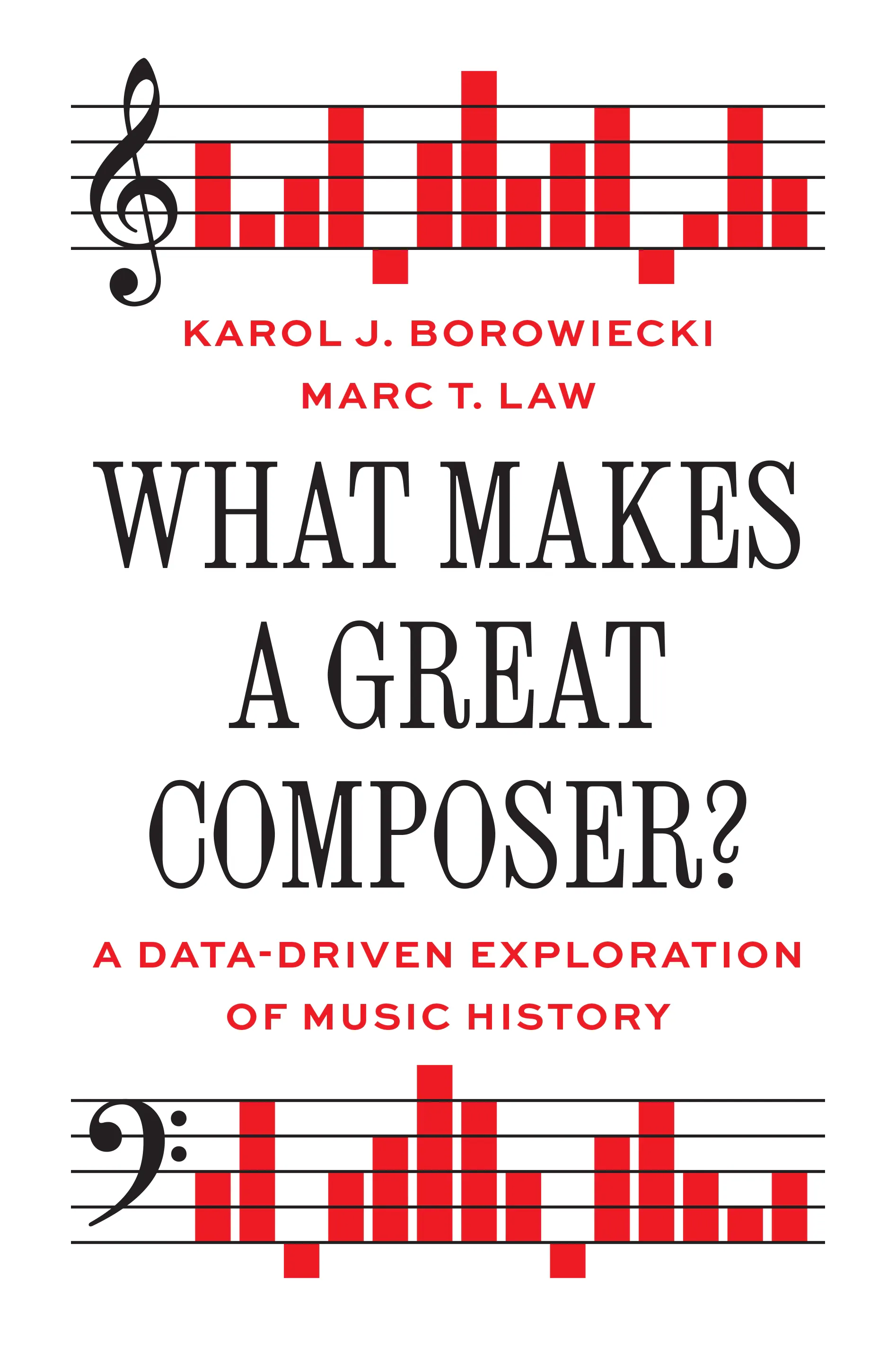
Why do some composers become immortal while others fade from view? In What Makes a Great Composer?, we combine economics, history, and large-scale quantitative data to show how training, cities, institutions, incentives, and unequal opportunity shaped the creativity, careers, and lasting reputations of classical composers over nearly one millennium.

Why do we still listen to Mozart’s music but not Salieri’s?
The question is simple. The answer is not. One tempting response is that Mozart was a genius. But that only restates the puzzle. It tells us that Mozart was extraordinary, but not how his gifts were cultivated, why his music endured, or why later generations continued to value it. Nor does it explain why some composers who were celebrated in their own time later faded from view, while others achieved their greatest recognition only posthumously.
In our forthcoming book, What Makes a Great Composer? A Data-Driven Exploration of Music History, we try to answer this question by combining economic reasoning with historical evidence and newly assembled data. We draw on the biographical entries of more than 16,000 composers—together with genealogies of who taught whom, expert rankings and modern streaming data—spanning nearly a millennium. Our aim is not to reduce musical greatness to numbers but to use data to uncover patterns that are otherwise difficult to observe.
We argue that composer greatness emerges from the interaction between creative capacity and the conditions under which creative work takes place. Composers differ in ability, temperament, ambition, and imagination. But they also acquire skills from teachers, learn from other composers, work in musical centers, respond to changing incentives and constraints, and depend on opportunities for performance and recognition. To understand why some composers became great, we need to examine the conditions that shaped the development, expression, and recognition of creative ability.
Measuring greatness
But before we can explain why some composers became great, we need to be clear about what “greatness” means. Greatness is not a single attribute. Some composers were extraordinarily prolific. Ludwig van Beethoven, Johann Sebastian Bach, and Wolfgang Amadeus Mozart stand out because they combined exceptional productivity with originality, influence, and lasting prominence. Other composers achieved a more narrowly defined form of greatness: a relatively small body of especially admired works (e.g., Maurice Ravel), a single iconic piece (e.g., Carl Orff’s Carmina Burana), or high standing in their own time that proved less durable over time (e.g., Giacomo Meyerbeer).
For this reason, we use several measures rather than one. We examine the length of biographical entries in major reference works, expert assessments, measures of lifetime productivity, evidence on musical originality and influence, and modern indicators of popularity. Each measure is imperfect. Yet, as Figure 1 shows, composers who score highly on one measure of greatness tend also to score highly on others. This gives us confidence that we are not simply measuring noise, while still preserving the idea that greatness has multiple dimensions.

Figure 1: How different measures of greatness align.
What shapes creative achievement?
Once greatness can be proxied in this way, the next question is what shaped it. Here the economist’s instinct is useful. Creative achievement can be understood as the result of inputs, incentives, and constraints. Composers needed skills, time, motivation, access to performers, and opportunities to be heard. They also worked within economic and social environments that made some creative paths easier than others.
One pattern that emerges clearly is the importance of training. No composer begins with a fully formed musical imagination. Composers acquired their craft through families, churches, private teachers, and, later, conservatories. Teacher-student relationships transmitted technique, stylistic knowledge, and professional connections. They also linked composers across generations. Musical originality, in this sense, did not mean creating from nothing. It often meant absorbing inherited forms and techniques deeply enough to transform them.
Cities mattered as well. Composers moved to places such as Vienna, Paris, and London because these cities offered concentrated musical resources: performers, patrons, publishers, audiences, teachers, and rivals. Such environments made it easier to learn, hear new works, and find opportunities for performance. But they also involved trade-offs: cities were expensive, crowded, and often unhealthy. Proximity to other composers increased output and recognition, but that greater competitive pressure was also associated with shorter lives. Cities could nurture creativity, but at the cost of making creative life more intense.
Institutions—the formal and informal rules and norms that shaped incentives, constraints, and rewards—mattered too. Composers needed to make a living. Some relied on patronage: support from courts, churches, or civic employers. Patronage could provide financial security and prestige. But it could also weaken incentives to innovate, especially when success depended on satisfying patrons rather than reaching broader audiences. As patronage declined, composers became more dependent on publishers, commissions, performing, and teaching. This market-oriented world created new opportunities, especially as copyright increased the returns from publication and circulation, but it also brought greater income risk. In this sense, creativity was embedded in the institutional environment in which composers worked.
The same framework also helps us think about exclusion. The history of classical music is also a story of opportunity distributed unevenly. Women faced barriers to advanced training, publication, public performance, and professional recognition. Some nevertheless shaped musical life in other ways: Clara Schumann as a performer, Nadia Boulanger as one of the twentieth century’s most influential teachers, and Fanny Hensel (née Mendelssohn) as a composer whose songs, piano pieces, and chamber works reflected the genres more often open to women. Accordingly, the surviving record reflects unequal access to the conditions that made such achievement possible.
Greatness in context
This brings us back to Mozart and Salieri. Genius matters, but composers did not create in isolation. They learned from others, worked within systems of training, patronage, publication, and performance, depended on cities and audiences, and faced constraints that shaped what they could write and whether their works would be heard. Our book shows that these forces were part of a broader set of influences—including emotional experience, war, displacement, migration, and chance—that shaped creative achievement and the reputations that endured.
Economics cannot tell us what it feels like to hear the finale of Mozart’s Jupiter Symphony, the slow movement of Beethoven’s Op. 130 string quartet, or the opening of Stravinsky’s The Rite of Spring. But it can help us understand the conditions under which such works were created, circulated, and remembered. The music remains mysterious, but our appreciation of it deepens when we see the conditions that helped make it possible.
About the book
Borowiecki, Karol J. and Marc T. Law (2026). What Makes a Great Composer? A Data-Driven Exploration of Music History. Princeton University Press.
Available for pre-order on Amazon (release date of 3 November 2026 in Canada and the USA and 5 January 2027 in Europe and the UK).
About the authors
Karol J. Borowiecki is a Professor of Economics at the University of Southern Denmark in Odense, Denmark.
Marc T. Law is a Professor of Economics at the University of Vermont in Burlington, Vermont, USA.
Abou the images
Left image: Portrait of Wolfgang Amadeus Mozart by Barbara Kraftt https://commons.wikimedia.org/wiki/File:Wolfgang-amadeus-mozart_1.jpg
Center image: Book cover https://pup-assets.imgix.net/onix/images/9780691257112.jpg
Right image: Portrait of Antonio Salieri by Joseph Willibrord Mähler, horizontally mirrored for layout purposes https://commons.wikimedia.org/wiki/File:Antonio_Salieri_painted_by_Joseph_Willibrord_Mähler.jpg